Cool Things to Laser Engrave (Beyond Coasters and Keychains)
At some point every laser owner opens the same cabinet and finds the same evidence: eleven coasters, a bag of keychains, three cutting boards, and a slate with the dog's face on it. Those are great first projects. They teach you focus, settings, and material behavior in about an afternoon.
Then they stop teaching you anything. You're running the same 90-second job on the same 4-inch circle and wondering why the hobby feels flat.
The fix isn't a bigger machine. It's picking projects with a different shape to them.
Why the coaster gets boring
A coaster is a flat blank with a design dropped on it. Nothing about the object changes what you put on it, and nothing about the design changes the object. It's a printout on wood.
The projects that stay interesting do at least one of three things:
- The material does something a coaster can't. Painted stock reveals a second color. Slate goes ghost white. Anodized aluminum comes back with a bright contrasting mark, though the exact shade depends on the coating.
- The object gets used, constantly. A thing on a shelf gets looked at once. A thing in a drawer gets picked up a thousand times.
- The design carries something that already mattered. Handwriting. A date. A face. A place.
Keep those three in your head and ideas stop being a list you scroll through. They become a filter.
PRINT. CUT. CARVE.
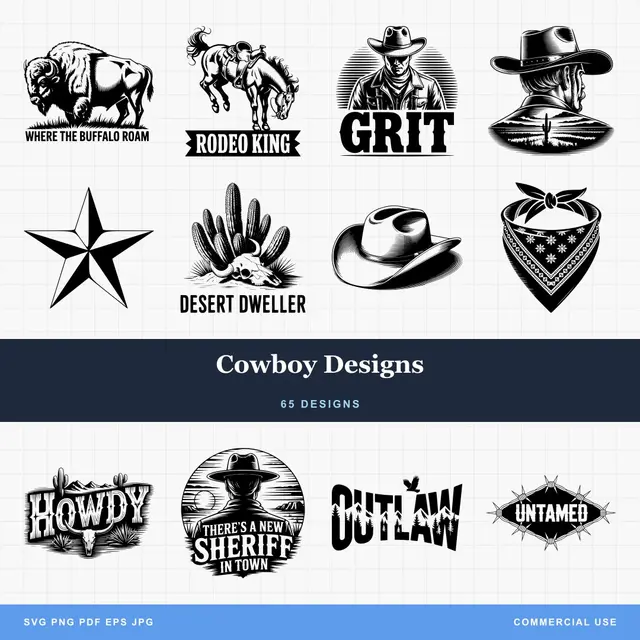
- Multiple formats (SVG, DXF, PNG)
- Machine-tested designs
- Commercial licenses
Sponsored by PrintCutCarve.com
Trade up from what you've already made
The fastest way out of the rut is to take a project you can already run in your sleep and bump it one level. Same skills, better object.
| You've made this | Make this instead | Why it's better |
|---|---|---|
| Coasters | A serving tray with a border pattern and a pull handle | Bigger canvas, real joinery, actually gets carried around |
| Keychains | A key rack with a shape cut for every hook | Lives on a wall, seen daily, reads as furniture |
| Cutting board with a name | A recipe board in the original handwriting | Same job time, ten times the emotional weight |
| A single engraved photo tile | A three-panel triptych in one frame | Same photo, way more presence |
| Christmas ornaments | A layered advent calendar with 24 doors | One project, twenty-four little wins |
| Name signs | A carved-looking house number panel for the porch | Outdoor durability, a real design problem to solve |
Nothing on the right column needs a machine upgrade. It needs a slightly bigger idea.
Things that get used every single day
Daily-use objects are the sweet spot. They're small, they're cheap in material, and every time someone reaches for one they notice it again.
A few that punch above their weight:
- Wooden spoon and spatula handles. Engrave the flat of the handle, oil it, done. A set of four with a kitchen's family name is a better gift than another board.
- A shop story stick. A hardwood stick with your actual bench-critical measurements burned in: your drawer depths, your saw kerf, your bed size. Purely functional, and nobody else has one.
- Garden row markers. Plant names on cedar or bamboo stakes. Cheap stock, batch job, and they look great in a raised bed.
- A tool shadow board. Cut the outline of each tool into a backing panel and engrave the label under it. Your pegboard turns into a shop you want to photograph.
- Cable and charger tags. Tiny tags that snap around a cord. Fifteen minutes of work, and the drawer of mystery cables finally makes sense.
- Light switch plates and drawer pulls. Ordinary house hardware that nobody expects to be custom. Guests always spot them.
- Guitar picks. Batch them out of thin stock. Musicians hand them out like business cards.
None of these are hard. They're just objects most people never think to personalize, which is exactly why they land.
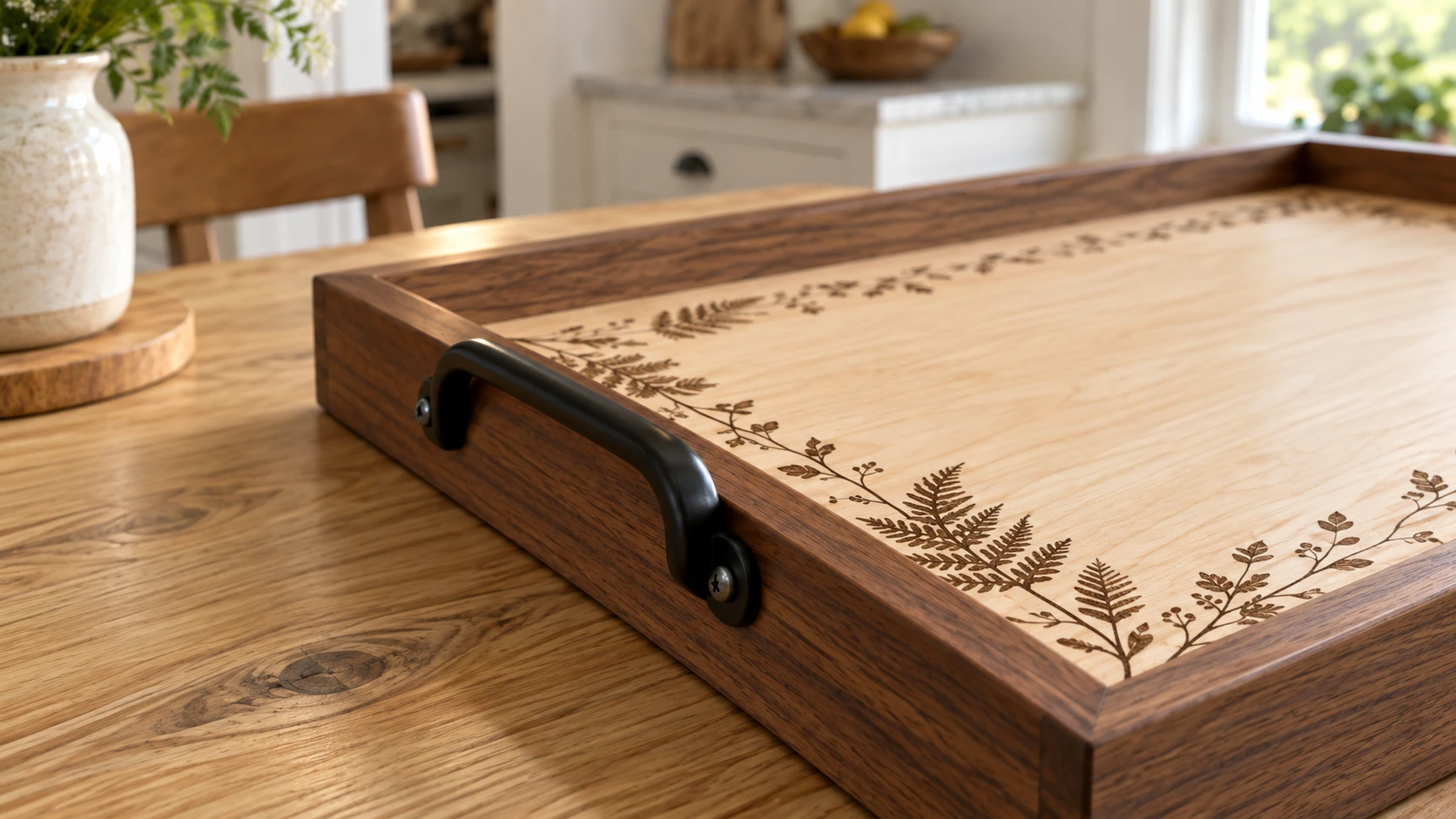
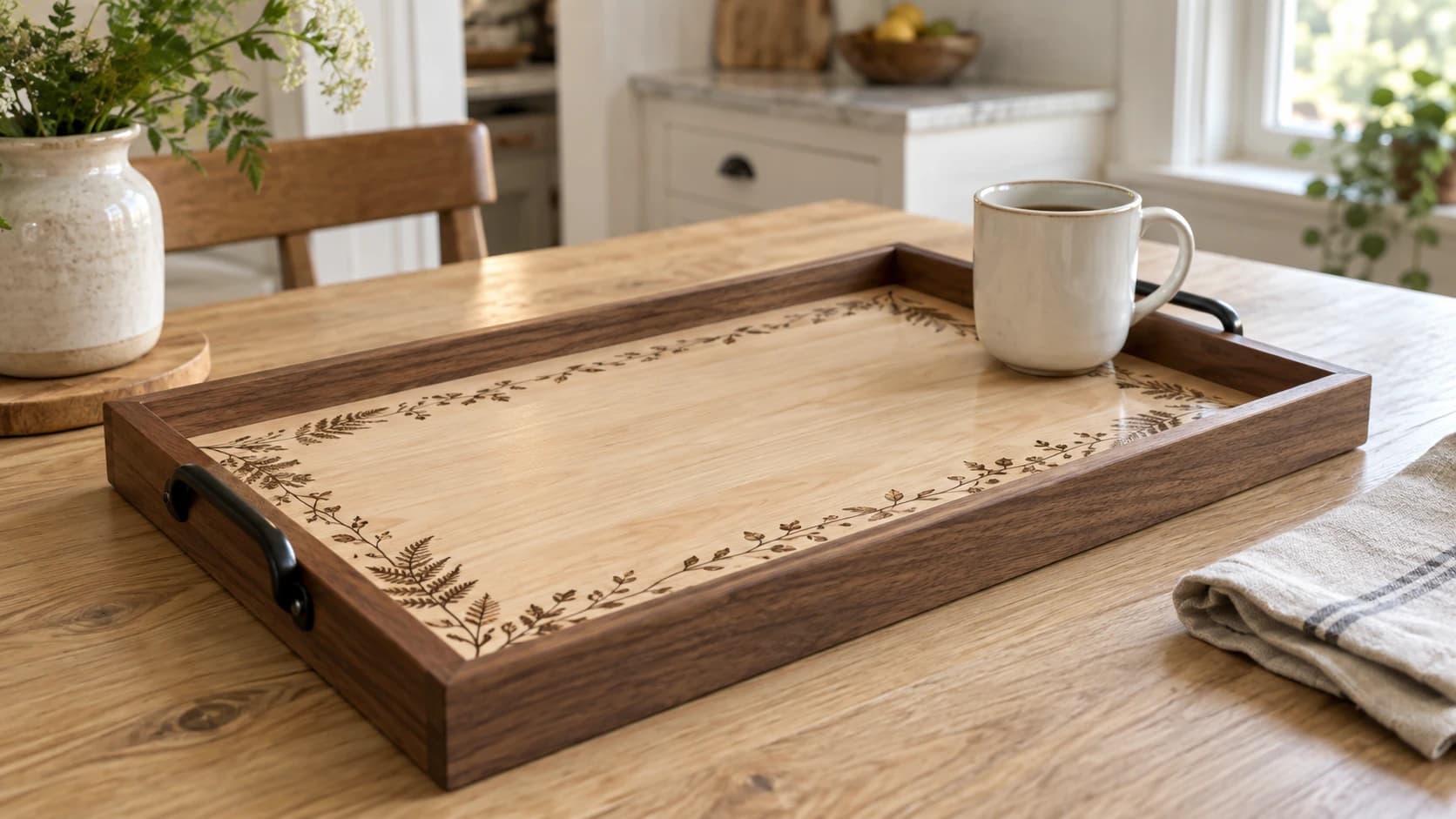
The tray combines a useful handle, a raised rim and decoration on its flat base. Keep the artwork clear of the joinery and hardware.
Things that hold a memory
This is the category people cry over, and it's the one worth getting good at.
Handwriting is the heavy hitter. A recipe card in a grandmother's script, engraved on a board that lives in the kitchen, is a completely different object than the same recipe in a nice font. Same with a signature, a note left on a fridge, or a kid's first attempt at writing their own name.
Faces are next, and they're where most people give up. Photos come off the laser muddy because a photograph is a smooth gradient, and most engraving workflows reproduce tone as a field of burned and unburned dots rather than as continuous shading. The image needs to be simplified into clean high-contrast marks before it goes anywhere near the bed. Photo Converter does that pass for you, turning a photo into pen-and-ink line art built for engraving, in standard black-on-light or inverted white-on-dark for slate and painted stock. It costs 1 credit per conversion. If you want the full walkthrough on wood specifically, we broke that down in how to laser engrave photos on wood.
Other memory pieces worth stealing:
- The floorplan of a first apartment, engraved on a small panel
- A trail map or coastline of a place someone hiked, sailed, or grew up on
- A kid's drawing, engraved at the scale they meant it to be
- A growth chart ruler along a length of oak, marked as the years go
- The label from a bottle that got opened for something important
Tip
Handwriting engraves best when you photograph it flat, in even light, with no shadow across the page. A phone photo straight down beats a scan on a curled page.
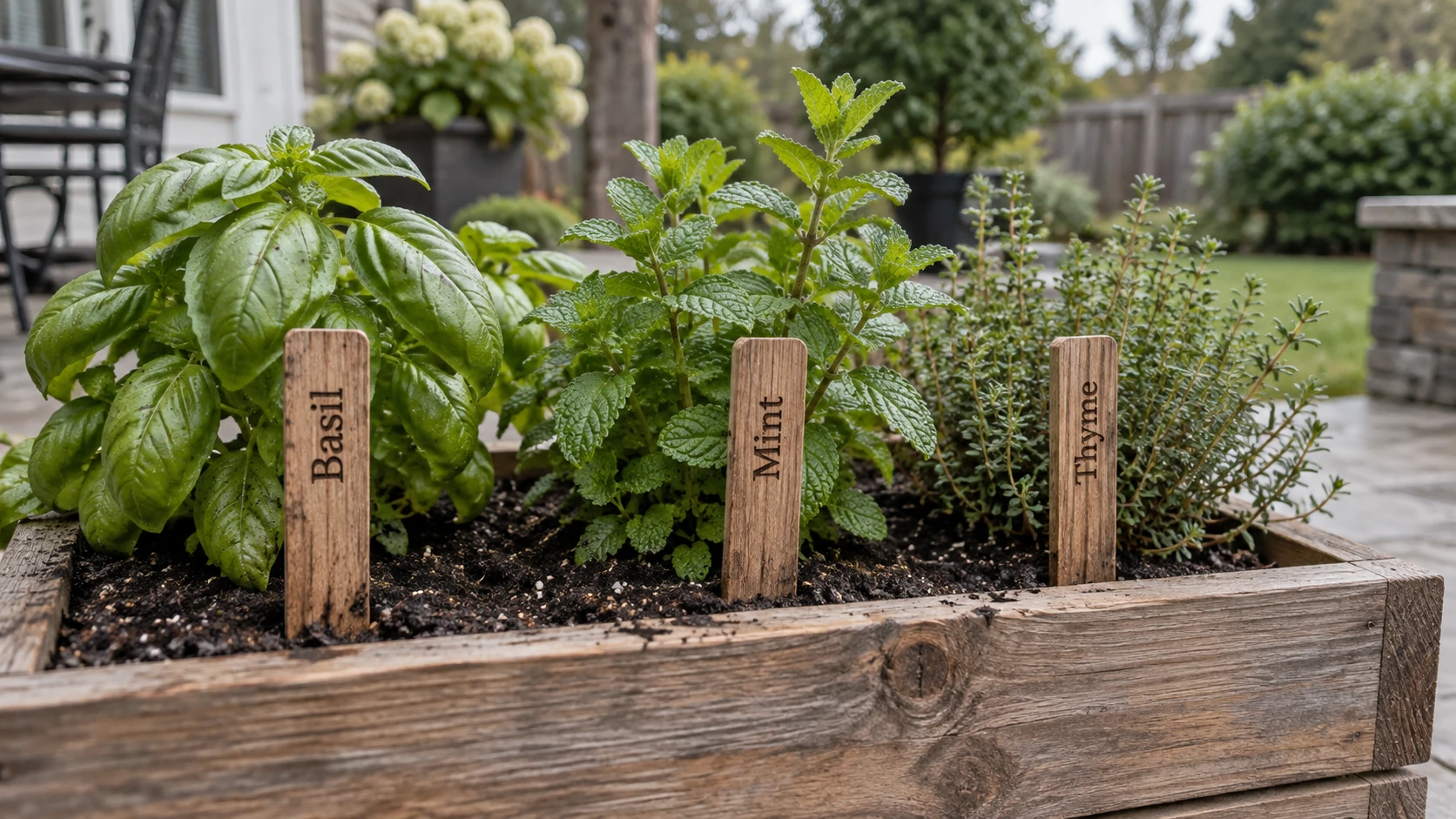
Garden markers are a separate everyday project: simple labels, grain running down each stake, and a finish chosen for the intended exposure.
Let the material carry the design
Half the "how did you do that" reactions come from the material, not the artwork.
Slate gives you near-white marks on near-black stone with no finishing at all. Painted or stained wood lets you burn through the top layer so the design comes out in the natural grain color underneath, which looks like inlay and often takes a single pass once you have dialed it in on a scrap. Cork, veneer, and thin bamboo all mark with a warmth that plain plywood never quite gets. Vegetable-tanned leather burns dark and smells like a campfire while it does it, and we covered the safety rules and settings approach in laser engraving leather.
The species matters more than most people expect too. Maple and basswood hold fine detail with clean contrast, while some woods char and blotch no matter how carefully you dial the settings. Our wood species guide is worth a skim before you buy a stack of anything.
Warning
Chasing an unusual material is fun right up until it's PVC. Chlorinated plastics release corrosive, toxic hydrogen chloride when they burn, which eats your machine from the inside and is genuinely bad to breathe. Plenty of vinyl and faux leather is PVC based, and unlabeled plastic could be anything. If you can't identify what a material is made of, don't put it in the laser.
Two moves that make a plain blank look designed
There's a gap between "engraved" and "designed," and it usually comes down to two things: a proper focal mark, and something filling the empty space.
For the focal mark, a monogram beats block text almost every time. The Monogram Generator builds split monograms, a name with a horizontal band running through it, and classic one-to-three-initial monograms with optional frames and borders. Pick a font category, adjust the band offset and frame size, and pull the SVG. It's free, no credits, and it turns a bare cutting board into something that looks like it came from a shop. There's more on layout and font choices in our custom monograms guide.
For the empty space, decorative fill is the trick sign makers have used forever. DecoFill takes a shape outline and fills it with scrollwork: 65 styles from Victorian to Norse to Japanese, a complexity slider from minimal to dense, and symmetry options including mirror, quad, and radial. It costs 1 credit per generation. Drop it inside a rounded rectangle for a sign background, inside a letter for a display initial, or in the border ring of a round plaque. We went deeper on style choices in decorative scrollwork patterns.
Those two together will carry an enormous number of projects. Frame, fill, focal point.
Projects that fold, hinge, or stack
If you want the satisfying stuff, stop thinking of the laser as a printer and start thinking of it as a parts factory.
Living hinges. A grid of thin kerf lines makes rigid plywood bend like fabric. That gets you curved lamp shades, rolling pencil cups, and boxes with a wraparound lid. It's the single most impressive thing a laser does and it costs you nothing but a test cut to dial in the spacing.
Finger-jointed boxes. Once you can cut a clean box, you can make anything box-shaped: a dice tower, a card case, a keepsake chest with an engraved lid. Boxes are also where engraving gets good, because you have an inside surface nobody expects to be decorated.
Stacked topography. Cut the same shape at slightly different sizes and stack it. Contour maps, layered mountains, a wave, a set of nested initials with depth. It reads as sculpture and it's just repeated 2D cuts.
Standing pieces with slot joints. Two flat parts and a slot make a piece that stands on a desk with no glue. Photo stands, phone docks, tabletop signs, a display easel for the pieces you're selling.
Mechanisms. Gears that actually turn, a marble run, a card with a sliding element. They're fiddly the first time and then they're not.
Info
Living hinge spacing depends on your material thickness and your kerf, so cut a test strip with three or four spacings before committing to a full lamp. Ten minutes of testing beats a warped shade.
Pick one this weekend
You don't need twenty new ideas. You need one project that isn't a flat circle.
Grab whatever scrap is closest, run one of the trade-ups from the table above, and add a focal mark and a fill so it doesn't look like a printout. Build a monogram for free with the Monogram Generator, fill the background with scrollwork from DecoFill, or turn a photo that means something into engravable line art with Photo Converter.
And if the first one comes out wrong, that's fine. That's what the cabinet is for.
Related Tools
Ready to try these tools?
Sign up free, no credit card required. Free tools available immediately.
Start Free