

How to Write Etsy Listings That Actually Rank
You made a good product. You photographed it, listed it, and now it lives on page 12 of Etsy search where no buyer has ever ventured. Meanwhile some shop with a worse product and better keywords is getting the sales.
That gap is almost never about the product. It's about the listing. The title, the tags, the first photo, the first two lines of the description. Those are the parts Etsy's search reads and the parts a buyer judges in under a second.
This post is about the listing itself: how Etsy matches searches to listings, and how to write each field so yours actually shows up. If you're still setting up your shop, start with our maker's guide to selling on Etsy and come back here when you're ready to sharpen individual listings.
How Etsy Search Decides What to Show
You don't need to reverse-engineer the algorithm, and anyone claiming to know exact ranking weights is guessing. Etsy's current Seller Handbook explains that search evaluates the whole listing: the title, tags, description, categories, attributes, first photo, and signals such as reviews. The practical process still has two parts.
First, matching. Etsy uses the information across your listing to understand what the item is and which searches it belongs in. Accurate categories and attributes matter alongside titles, tags, and descriptions, so leaving fields blank or choosing a vague category gives search less useful information. Use specific buyer language, but do not force the same phrase into every field.
Second, ranking. Among the relevant listings, Etsy considers signals such as how shoppers engage with a listing, listing and shop quality, customer service, and the individual shopper's context. Those signals and their weighting can change, so treat fixed formulas and guaranteed-ranking claims as warning signs.
The practical takeaway: your job is to match the searches your buyer actually types, then earn clicks once you appear. Everything below serves one of those two goals.
PRINT. CUT. CARVE.
- Multiple formats (SVG, DXF, PNG)
- Machine-tested designs
- Commercial licenses
Sponsored by PrintCutCarve.com
Titles: Name the Item Clearly
You get up to 140 characters, but that is a ceiling, not a target. Etsy's April 2026 guidance recommends clear, scannable titles and suggests keeping them under about 15 words when possible.
"Rustic Farmhouse Charm Handcrafted With Love" never plainly identifies the product. Start with what the item actually is, then add the few objective details a shopper needs to distinguish it.
A few rules that match the current guidance:
- State the item first. A shopper should understand what you sell without decoding a string of adjectives.
- Add only essential traits. Material, color, size, style, or personalization belongs in the title when it objectively distinguishes the product.
- Keep it concise and readable. Aim for fewer than 15 words when that still describes the item accurately. Do not fill all 140 characters just because they are available.
- Move occasion language elsewhere. Phrases such as "gift for her" or "perfect birthday gift" usually belong in tags and descriptions unless the occasion is essential to what the item is.
- Avoid repetition and promotion. Repeated words, sale language, shipping claims, and subjective praise make a title harder to scan without explaining the product.
Here's the difference in practice:
| Title | What it matches | |
|---|---|---|
| Weak | "Beautiful Handmade Rustic Gift Crafted With Love" | Does not clearly identify the item |
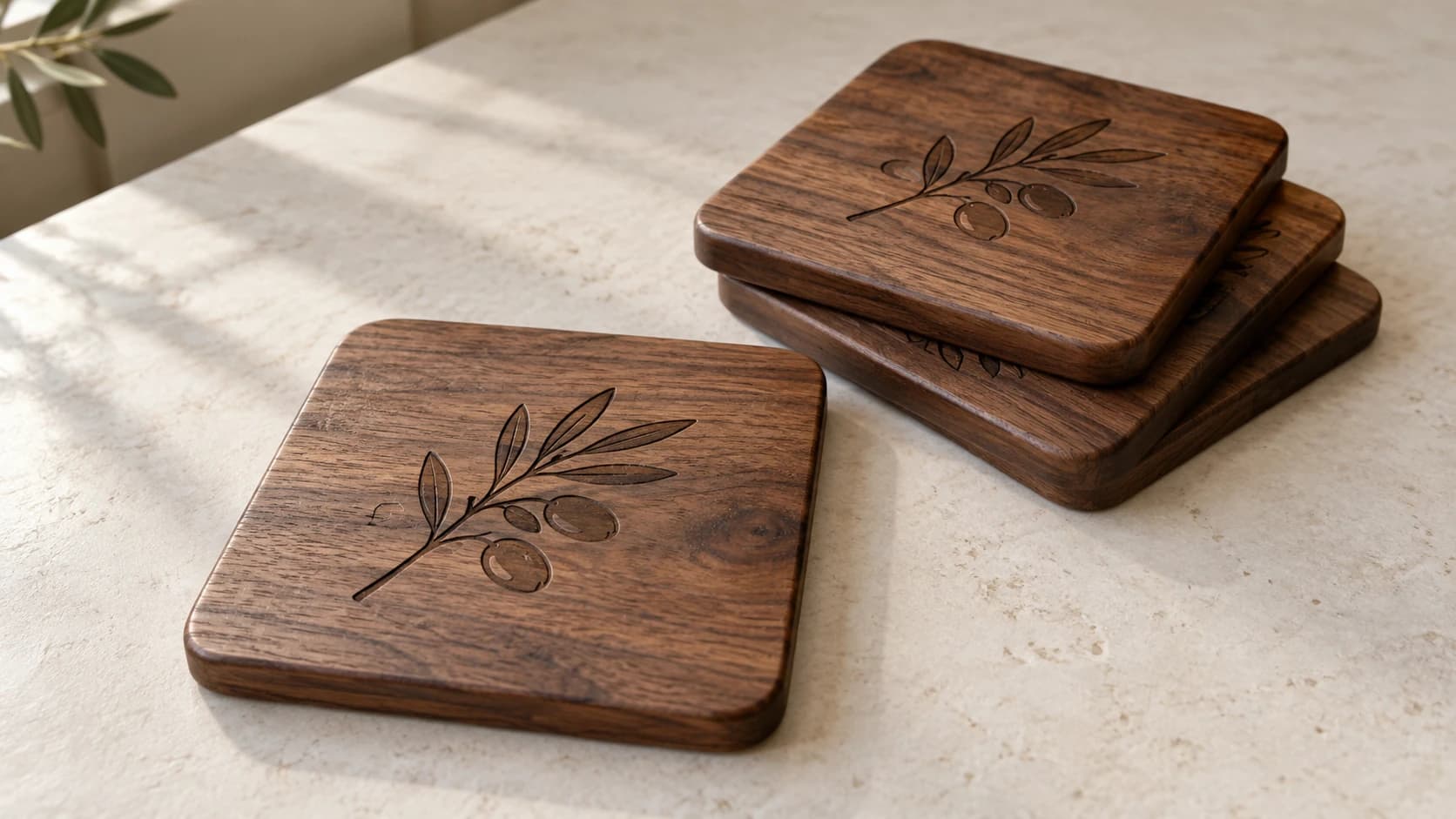
| Strong | "Engraved Walnut Coaster Set — Personalized Set of Four" | Names the item and its essential traits |
The strong title is not clever or stuffed. It tells the shopper exactly what the product is and why this version is distinct.
Tags: All 13, No Wasted Slots
Etsy gives you 13 tags of up to 20 characters each, and every empty slot is a search you've chosen not to appear in. Use all 13, every listing, no exceptions.
The part most sellers get wrong is spending tags on phrases already sitting in the title. Your title and tags both feed matching, so a tag that duplicates a title phrase word-for-word buys you very little. Etsy's own guidance is to use multi-word phrases and to diversify rather than pile up variations of one term.
Spend your 13 slots across different angles of the same product:
- What it is: "walnut coaster set," "wood coasters"
- Who it's for: "gift for couple," "new homeowner gift"
- The occasion: "housewarming gift," "5th anniversary"
- The style: "modern rustic decor," "minimalist coaster"
- The material or method: "engraved wood," "personalized wood"
- Where it lives: "coffee table decor," "kitchen gift"
Skip plurals of tags you already have (Etsy handles that), skip misspellings (search corrects them), and skip single generic words like "wood" or "gift" that put you against millions of listings. A specific three-word phrase with modest traffic beats a one-word tag you'll never rank for.
Tip
Categories and attributes work like extra tags. When you pick "Coasters" as your category, you don't need a "coasters" tag anymore, which frees a slot for a phrase the category doesn't cover. Fill in every attribute Etsy offers for the listing: color, occasion, holiday, recipient. Each one is free matching surface.
Let ListingLab Draft the Hard Part
Writing a keyword-dense title and 13 non-overlapping tags is exactly the kind of work that takes a person 40 minutes and still feels like guessing. It's also exactly what ListingLab was built for.
Upload a photo of your product and it generates three Etsy-optimized title options, full descriptions, a set of 13 SEO tags, and key feature bullets, all derived from what's actually in the photo. You pick the title that fits your shop's voice, swap any tags that don't match your buyer, and paste. The generated tags tend to cover the angle spread above (occasion, recipient, style, material) better than most sellers do by hand, because it's not anchored to the one phrase you've been staring at all week.
You need a signed-in Craftgineer account. Text generation draws on the chat messages included with your plan, and the optional AI product photos, 35+ staged styles for seasonal and lifestyle shots, cost one credit each. We covered those in depth in AI product photos for Etsy.
Treat the output as a strong first draft, not gospel. You know your buyer better than any model does. If your coasters sell mostly as groomsmen gifts, make sure a tag says so, even if the AI led with housewarming.
Descriptions: The First Two Lines Do the Selling
Etsy has said its search also considers descriptions, but that's not why the opening matters. It matters because on mobile, buyers see roughly the first two lines before "read more," and most never tap it.
So don't open with your shop's origin story. Open with the thing the buyer needs to know to keep reading:
Weak opening: "Welcome to my shop! I've been woodworking since 2015 and every piece is made with care in my home studio."
Strong opening: "A set of four solid walnut coasters, engraved with your family name or a design you choose. Sealed against water rings, sized for oversized mugs, and shipped in a gift-ready box."
What it is, how it's personalized, why it's good, how it arrives. Two lines.
After the opening, structure the rest so a skimmer can find answers: dimensions and materials, exactly how personalization works and what you need from the buyer, care instructions, processing time. Every unanswered question in a description becomes either a message you have to answer or a sale that quietly walked away.
Info
Write the description for the buyer, not the algorithm. Your keywords already live in the title, tags, categories, and attributes. Stuffing them into the description reads badly to the one audience that actually pays you.
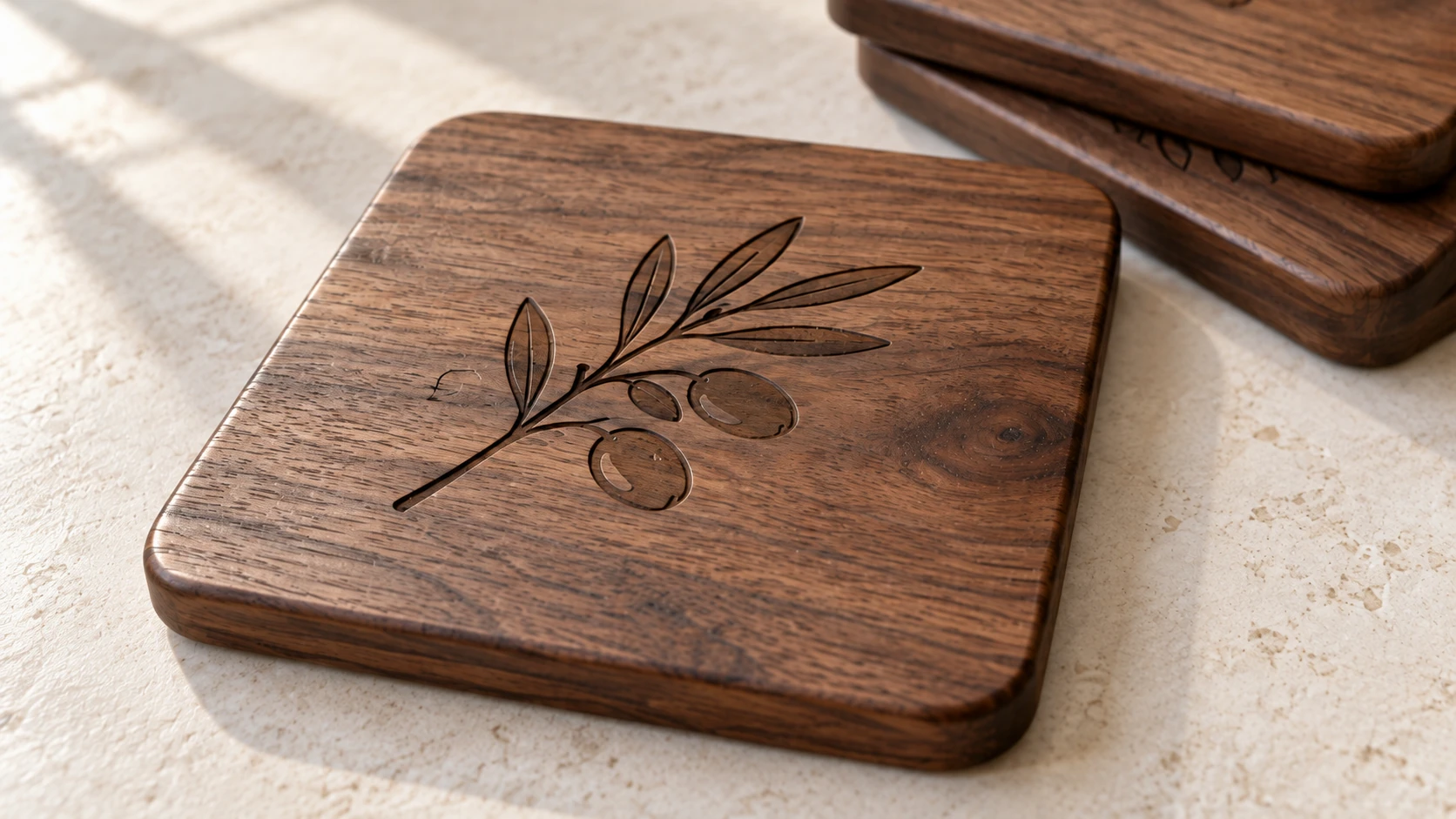
A detail view of the same set makes the engraving, finish and wood grain easier to judge. It answers a different question from the full-product photo.
Photos: The First One Has a Single Job
Search results are a wall of thumbnails. Your first photo has one job: make your product legible and appealing at postage-stamp size. Whole product visible, clean background, no props competing for attention, no important detail hiding in a corner that vanishes at thumbnail scale.
Order the rest deliberately rather than uploading in whatever sequence your camera roll offers:
- Hero shot: clean, full product, this is your thumbnail
- Detail shot: engraving crispness, grain, stitching, the quality evidence
- Scale shot: the product next to a mug or a hand, so size is felt, not read
- In-use shot: the product living where it will live
- Personalization example: what a customized version looks like
- Packaging: especially if it's giftable
Etsy gives you ten photo slots plus up to two listing videos. You don't have to force filler into every slot, but five or fewer photos with no scale reference leaves useful buyer questions unanswered. For the actual shooting, lighting, and phone-camera setup, we've got a full walkthrough in product photography tips for makers.
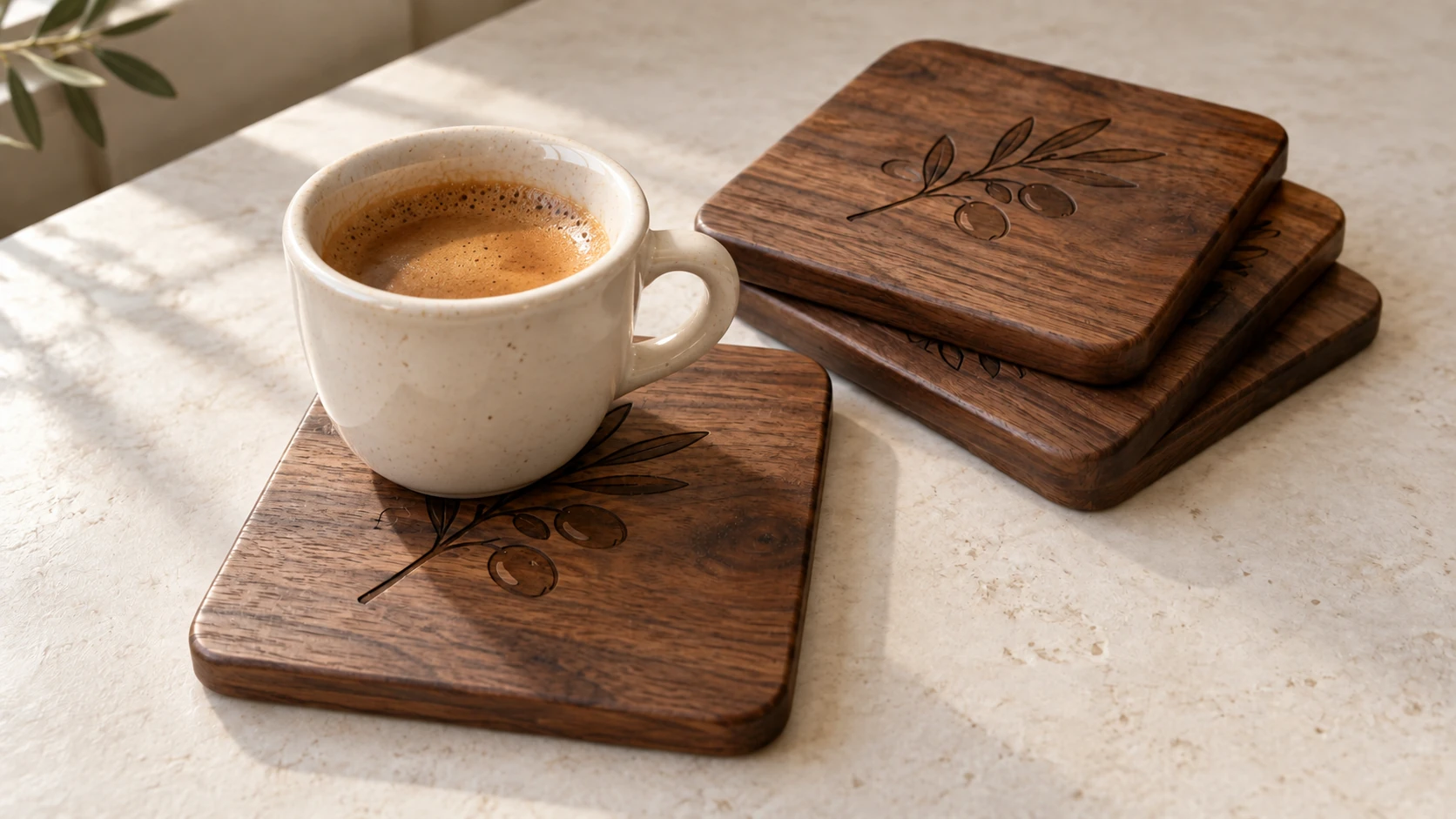
A familiar object gives the same product context and a sense of scale. Keep the material, design and setting consistent throughout a related photo set.
Price and Shipping Are Ranking Signals Too
Two listing fields that don't look like SEO but behave like it:
Shipping. Etsy has been open that shipping price factors into US search, and buyers filter for free shipping regardless. Building average shipping into the item price and offering free shipping is usually the stronger play for small items. If your product is heavy or oversized, calculated shipping keeps you from eating the difference.
Price. Price doesn't rank you directly, but it drives click-through and conversion, and those do. A price wildly below your competitors reads as "something's wrong with it," and a price wildly above needs photos and copy that justify it. If you haven't actually costed out your work, do that first. Our guide to pricing handmade products walks through the math so you're competing on value instead of racing to the bottom.
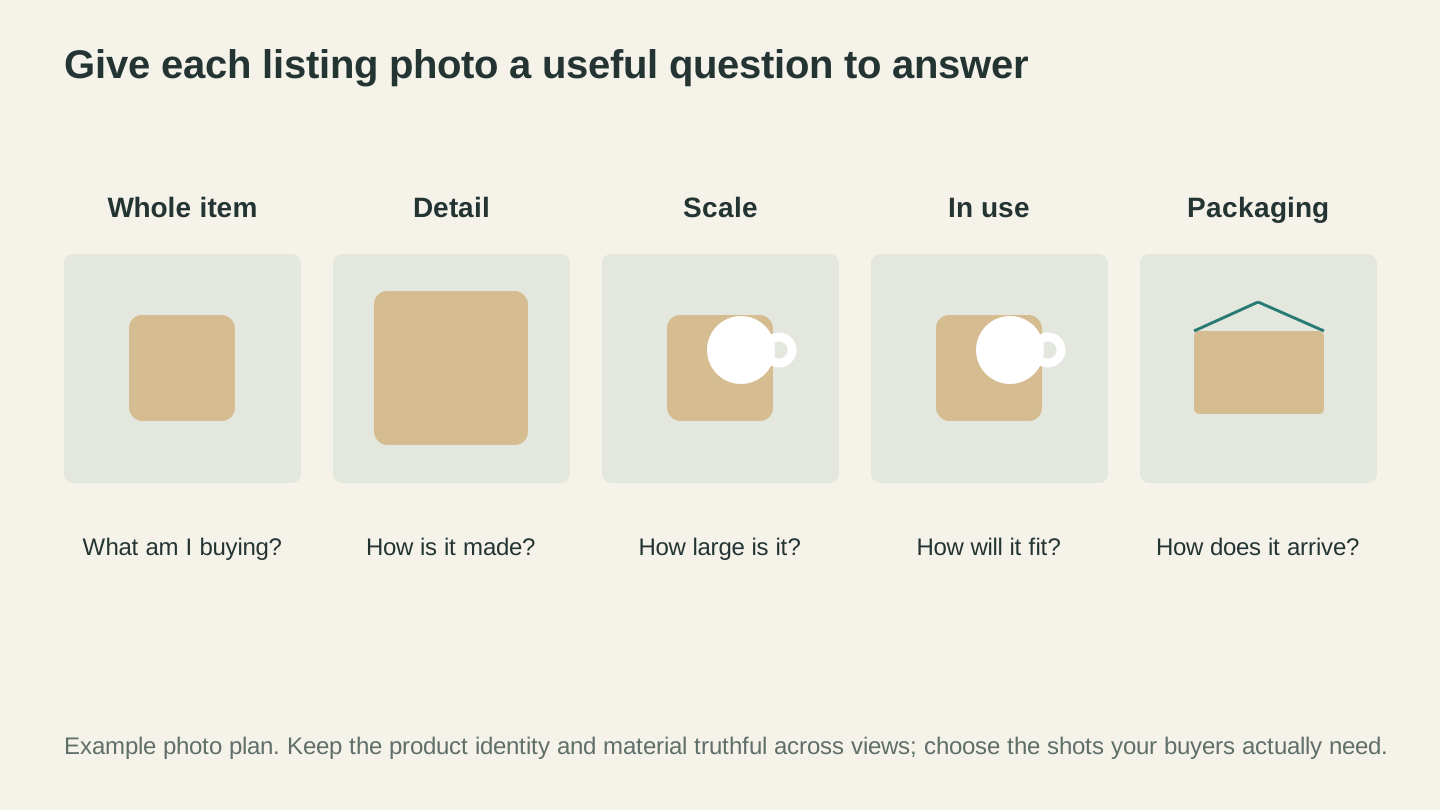
Plan each image around a buyer’s question. Add another view when it provides useful information about the actual item.
Iterate With Etsy Stats, Not Vibes
A listing isn't finished when you hit publish. Etsy's Stats page tells you exactly where each listing is failing, if you know which number to look at.
Views but no favorites or orders? The listing is matching searches and earning clicks, then losing people. Look at your price, your first two description lines, and whether your photos answer the size and quality questions.
Barely any views at all? You have a matching problem. Check which search terms are bringing what little traffic you get, then rewrite the title and tags toward terms with more life in them. Regenerating a fresh set with ListingLab and comparing it against your current tags is a fast way to find angles you missed.
Traffic from one search term only? You're over-concentrated. Spread your tags across more angles so one shift in that term's popularity doesn't zero out the listing.
Change one thing at a time and give it a few weeks before judging. Etsy needs enough visits to produce a real signal, and if you change the title, tags, and price in the same week, you'll never know which change did what.
Frequently Asked Questions
Do I have to use all 140 title characters?
No, and cramming to hit 140 usually backfires. Use as many characters as you have real search phrases for, in readable order. Three strong phrases beat six weak ones.
Should tags repeat words from my title?
Some overlap is unavoidable and fine. What you want to avoid is a tag that duplicates a full title phrase word-for-word, because that slot could have matched a search your title doesn't cover.
Does renewing a listing boost it in search?
Renewed listings get the same temporary recency consideration new listings do, but it's small and it costs a listing fee each time. Fixing a weak title and tags is almost always worth more than repeatedly renewing a poorly matched listing.
How long until listing changes affect my ranking?
There's no published number. Give a revised listing a few weeks of traffic before judging the change, and resist editing your best sellers out of boredom.
Rewrite One Listing Today
Don't overhaul your whole shop tonight. Pick your best product with the worst stats. Upload its photo to ListingLab, generate titles, tags, and a description, and merge the best of it with what you know about your buyer. Fix the photo order while you're in there.
Then let it run, watch the stats, and do the next one. Ranking on Etsy isn't a trick. It's thirteen tags, a title someone would actually type, and a first photo that earns the click, repeated across every listing in your shop.
Related Tools
Ready to try these tools?
Sign up free, no credit card required. Free tools available immediately.
Start Free