

30 Useful Things to 3D Print (That You'll Actually Use)
Open the drawer. You know the one. Benchies, a Pikachu with a rough overhang, three calibration cubes, a low-poly fox, and an articulated slug that was hilarious for about four minutes. Somewhere under all that is a spool receipt you never opened.
Nothing wrong with any of it. Trinkets are how you learn the machine. But at some point the novelty fades and the spool cost stops feeling like tuition, and you start wanting prints that earn their shelf space.
Here are 30 that do. They are grouped by where they live, and the ones worth real attention get real attention. I cut the filler, so you will not find "phone stand" listed four different ways.
The Drawer Test
Before the list, here is the filter I use. A print is worth making if it does at least one of three things:
It replaces something you would otherwise buy. A $14 organizer, a $9 bracket, a $30 specialty jig. Filament costs pennies per part.
It solves a recurring annoyance. Not a hypothetical problem. A real one that irritates you at least weekly. The cable that slides behind the desk. The lid that never fits back in the drawer.
It fits your exact situation and nothing off the shelf does. This is where a printer stops being a toy. Nobody sells a bracket for your particular shelf, your particular hose, your particular weird appliance.
If a print does none of those, it is a trinket. Trinkets are fine. Just know which one you are making before you commit four hours of machine time.
PRINT. CUT. CARVE.
- Multiple formats (SVG, DXF, PNG)
- Machine-tested designs
- Commercial licenses
Sponsored by PrintCutCarve.com
Workshop and Garage
This is where a printer pays for itself fastest, because workshop problems are specific and commercial solutions are expensive.
1. Wall-mounted tool holders. Not a generic pegboard hook. A holder cut to the profile of your actual chisels, your actual pliers, your actual clamp handles. When every tool has a slot shaped like itself, you can see what is missing at a glance, which is the real reason shadow boards work.
2. Dust and shop-vac adapters. The single most useful category of print in any workshop. Every vacuum hose, every tool port, and every fitting seems to be a different diameter, and the adapter you need is either $22 or does not exist. Model a two-sided cone, print it in PETG, and you have a permanent fix. Most people print a dozen of these over a year and never regret one.
3. Router and drill bit index blocks. A block with holes sized to your bits, labeled. Sounds trivial. Saves you from squinting at shank markings under bad shop lighting for the rest of your life.
4. Clamp pads and soft jaws. Slip-on pads for F-clamps and vise jaws so metal never touches your workpiece again. Print these in TPU. The grip is dramatically better than the hard plastic pads that came with the clamps, and they do not slide when you tighten down.
5. Sandpaper cutting jig. A simple frame with a blade slot that tears a full sheet into perfect quarters or thirds every time. Ten minutes of print time to permanently stop tearing sandpaper crooked against the edge of your bench.
6. Setup and feeler gauges. Fixed-thickness blocks for setting blade height, fence offset, laser focus, and nozzle gap. Print a set in 1mm steps, label them, hang them on a ring.
7. French cleat bins and holders. If your shop wall runs on cleats, printed bins snap into the system perfectly and cost almost nothing. Build the wall once and print holders for the rest of your life as needs come up.
For a deeper run at this category, we have a whole post on 3D printed jigs and fixtures with more specific builds.
Tip
Anything that lives near a heat source, sits in a car, or takes real mechanical load should be PETG, not PLA. PLA starts to soften around 60°C, which a parked car in summer will absolutely hit. A dust adapter in a cold shop is fine in PLA. A phone cradle on a dashboard is not.
Kitchen and Around the House
Household prints have a shorter path to being used, because everyone in the house immediately understands what they are for.
8. Bag clips. The classic, and still correct. Print ten in an afternoon, put them in a drawer, never buy chip clips again. Make them in a color you can spot in a dark cupboard.
9. Shelf and fridge risers. Small stepped platforms that let you see the back row of jars instead of excavating for them. Print a couple in the depth your shelf actually is, which is the part store-bought risers always get wrong.
10. Door stops and cabinet bumpers. Wedge stops for doors that swing into walls, and thin bumper pads for cabinet doors that clack. Bumpers in TPU are quieter than the felt ones and do not fall off after a year.
11. Soap dish with a drain channel. A dish with angled ribs and a channel that runs the water off the edge instead of turning the bar into slime. Small print, disproportionate daily satisfaction. PETG here, since it lives permanently wet.
12. Broom, mop, and tool wall clips. Spring-arm clips that grab a handle when you push it in. A wall of these turns the corner where all your long-handled things fall over into an actual storage wall.
13. Furniture feet and floor protectors. Replacement feet for the chair that lost one, plus glide caps for anything that scratches your floor. Print the caps oversized and TPU them if you want silent chairs.
14. Measuring spoon and lid organizers. A rack that holds lids upright by size, or a rail that keeps measuring spoons in order. The lid one in particular ends a genuinely stupid daily fight.
Desk, Cables, and Tech
15. Cable clips and under-desk trays. Cable management is the most-printed category on earth for a reason. Adhesive-back clips, routing channels, and a tray that screws to the underside of your desk to hold the power strip and the brick pile. Do this once and your desk looks twice as expensive.
16. Charging dock, not a phone stand. A phone stand is a trinket. A dock cut to your phone with a channel for the specific cable you use, sitting where you actually put your phone down, is a useful print. The difference is fitting it to your situation instead of printing a generic wedge.
17. Headphone hook for the desk edge. Clamps on, no adhesive, holds the headset off the desk surface. Two hours of print time to reclaim a permanent chunk of desk.
18. Remote and controller wall holders. A rack by the TV that holds each remote in its own slot. Ends the couch cushion search.
19. Camera and tripod accessories. Cold shoe mounts, quick-release plate adapters, lens caps, filter cases, and mounts for sticking a small camera onto things it was not designed for. Photo accessories are absurdly overpriced, which makes this one of the highest-value categories going.
20. Vented laptop stand. Angled, open underneath, sized to your machine. Runs cooler and puts the screen at a height that stops wrecking your neck.
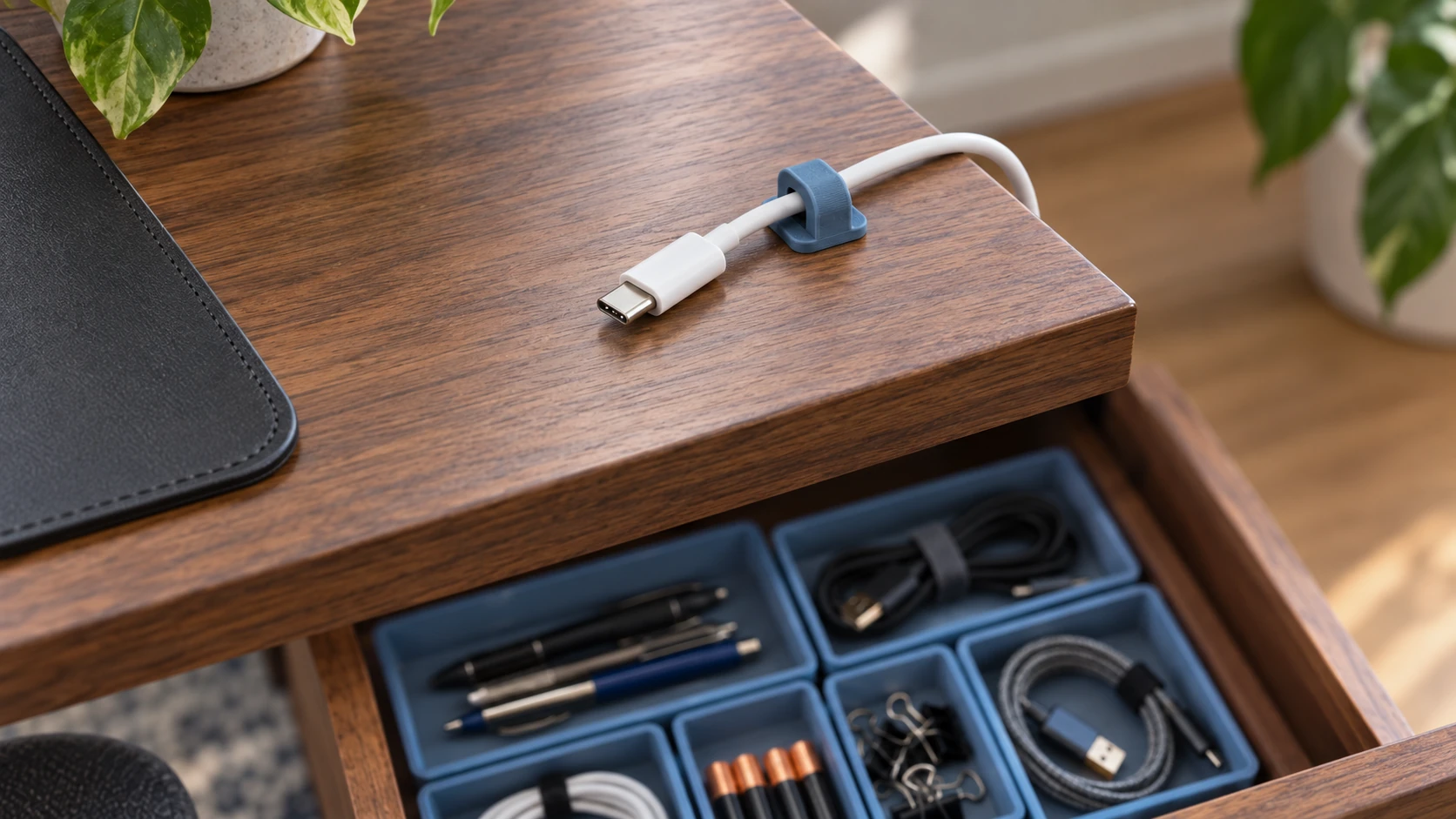
A small cable holder solves one specific annoyance: the charging plug stays on the desk where you can reach it.
Storage That Actually Fits
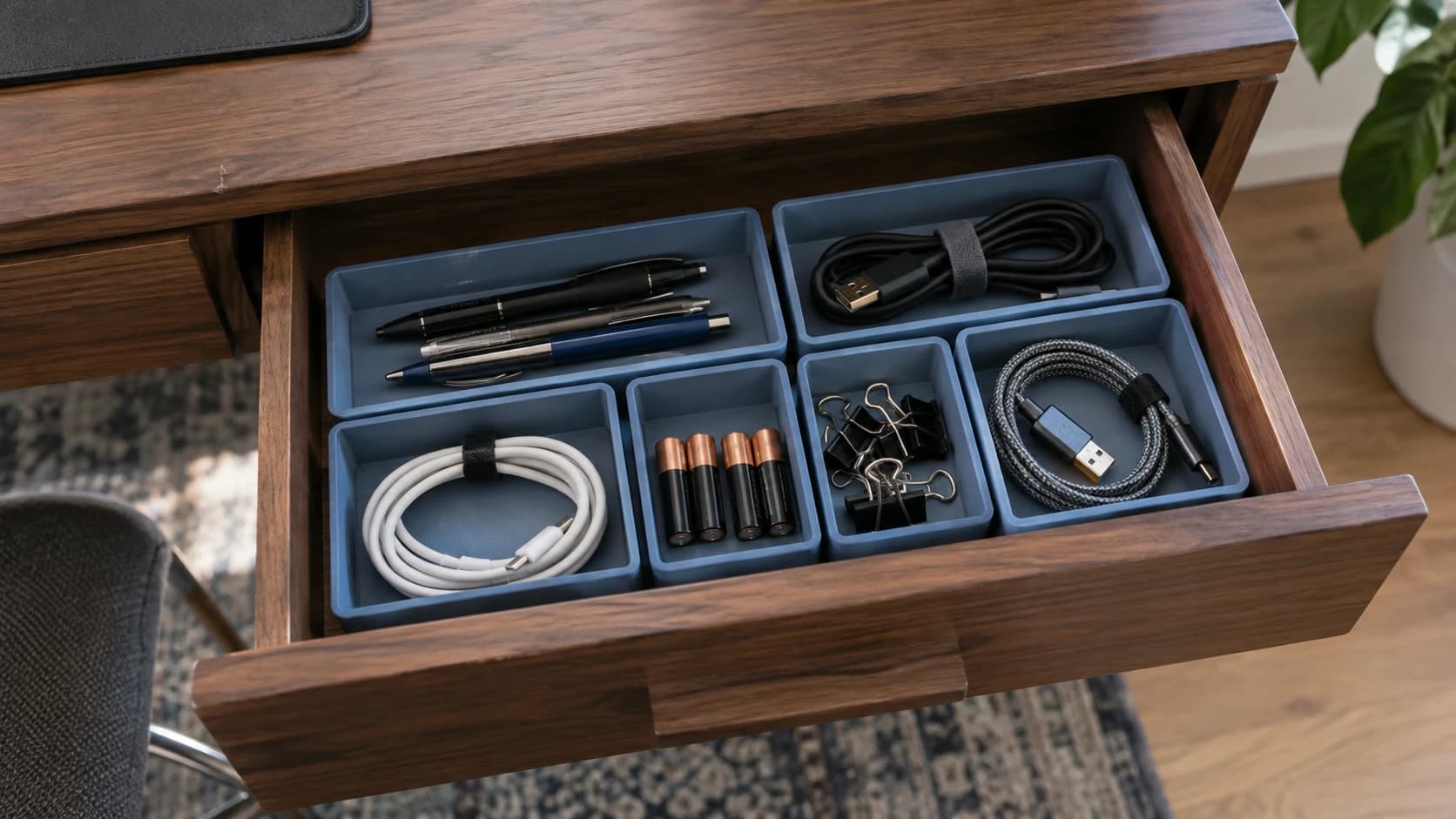
21. Modular drawer bins. The open Gridfinity standard is the big one here: a grid baseplate plus snap-in bins in any footprint, so a drawer of loose junk becomes a drawer where everything has a spot. It is a rabbit hole. Once you start, you will re-bin every drawer in the house. Print baseplates in PLA and bins in whatever color-codes your categories.
22. Labeled hardware sorting trays. Small stackable trays with the label printed into the front face, so it never peels. Screws, washers, standoffs, spare printer parts.
23. Filament spool accessories. Side mounts that hang spools off the printer frame, desiccant canisters that sit inside the spool hub, and clips that stop the loose end from unwinding into a tangle. Your printer maintaining itself has a nice symmetry to it. See our filament guide for more on keeping filament dry, since wet filament causes more failures than almost anything else.
24. Bottle and jar racks. Angled racks for paint bottles, resin dyes, spice jars, or seed packets. Sized to your bottles, which is the whole point, because the commercial racks are always sized to somebody else's.
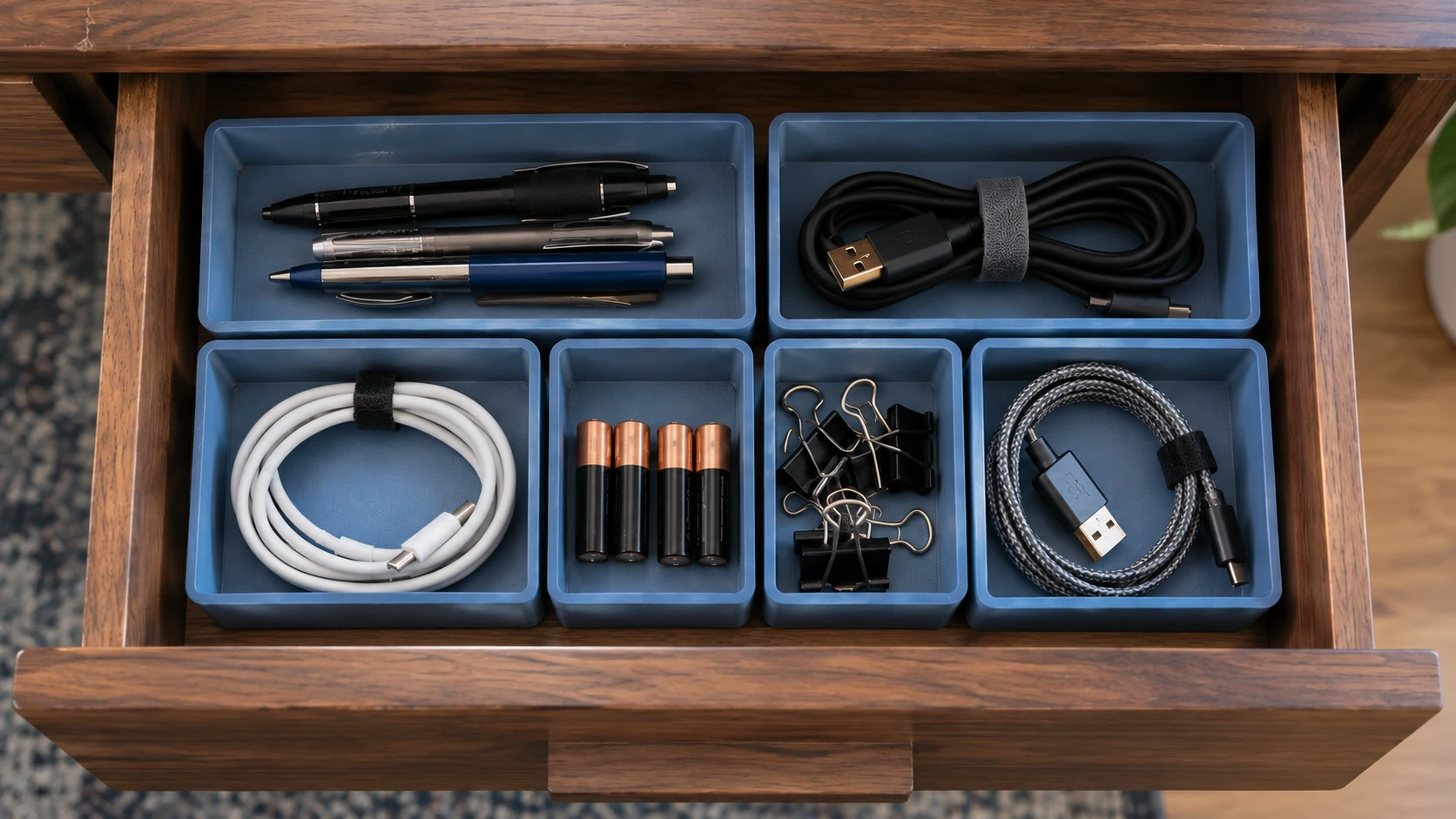
Size bins around both the drawer and its contents. Narrow gaps leave room to lift individual bins out without wasting the space between them.
Repairs and Replacements
This category is the one that converts skeptics. Nothing makes the case for a printer like fixing something that was headed for the trash.
25. Knobs, handles, and pulls. Oven knobs, drawer pulls, the dial off the dryer. These are the exact parts manufacturers stop stocking three years in, and they are simple shapes with a square or D-shaped shaft hole.
26. Appliance clips and brackets. The $2 piece of plastic inside a $500 appliance that snaps and takes the whole thing out of service. Dishwasher rack clips, fridge shelf supports, vacuum latches. Print in PETG so the replacement outlasts the original.
27. Battery doors and remote covers. Endlessly lost, never sold separately. A flat plate with a couple of tabs, twenty minutes of print time.
Warning
Printed replacement parts are for non-critical, non-load-bearing, non-heat-exposed jobs. Do not print anything that holds a person up, carries electrical load, contacts food or drink unless the specific filament and hardware are certified for it, or sits inside a hot appliance. Fixing a dishwasher rack clip is fine. Fixing a gas fitting is not.
Prints People Keep
The three above categories are about utility. These earn their spot a different way: people actually hang on to them.
28. Flat multicolor art. A logo, a crest, a map, a band mark, printed flat as separate color regions instead of painted on. MosaicFlow takes an image, separates it into color regions where each color is its own independent piece, and gives you a 3MF with the color assignments already in it. Uploads and previews do not charge credits. AI generation uses credits. Downloads require an active paid subscription or a current unlock for that design. It makes coasters, wall pieces, and door signs that look like they came from somewhere.
We walk through the full workflow in multicolor 3D prints from images, including how to match your color count to your available filament slots.
29. Relief plaques and lithophanes. A photo, converted into height instead of color, so the print reads as an image when light passes through it or rakes across it. ReliefMaker does the conversion: its fast local engine is free, and the Gemini quality mode costs one credit. Backlit in a frame or a night light, a lithophane of somebody's dog is the single highest hit-rate gift a printer can produce. The lithophane guide covers the printing side, and photo to 3D relief covers carved and non-backlit versions.
30. A cradle shaped exactly like the thing it holds. The catch-all, and honestly the best one on the list. A tray molded around a specific set of keys. A stand that matches the profile of a specific instrument. A case that fits one specific tool. Nobody sells these because the market is one person. That is the whole reason you own the machine.
What to Print It In
Material choice does most of the work in whether a functional print survives. A rough guide:
| What you're printing | Material | Why |
|---|---|---|
| Bins, trays, organizers, indoor holders | PLA | Cheap, easy, dimensionally stable indoors |
| Workshop adapters, wet areas, anything in a car | PETG | Handles heat and impact, does not get brittle |
| Clamp pads, bumpers, grips, feet | TPU | Grips, absorbs shock, stays quiet |
| Parts under real mechanical or heat load | ABS or ASA | Strong and heat resistant, needs an enclosure |
| Decorative and gift prints | PLA | Best color range and surface finish |
Tip
For anything that has to fit onto something else, print a 20mm test coupon of just the fitting feature before committing to the full part. Most people start with about 0.2mm of clearance per side for a slip fit and tighten from there, but every printer lands differently. Five minutes of test print beats a four-hour part that is 0.3mm too tight.
What Not to Bother Printing
Being honest saves you filament:
- Anything with a good cheap version. Zip ties, basic hooks, generic containers. A bag of 100 zip ties costs less than the print time.
- Threaded fasteners. Printed screws and bolts strip. Buy hardware, print the part around it, and use heat-set inserts if you need threads in plastic.
- Anything needing real precision under load. Gears and mechanisms are fun, but a printed replacement in a drivetrain will fail at the worst moment.
- Duplicates of things already in the drawer. Look first. The most-printed model in every household is the one somebody already printed last month.
Go Fill a Different Drawer
Pick one thing that bugged you this week. The cable, the lid, the tool with nowhere to live. Print a fix for that specific problem before you print anything from a list, including this one, because the print that solves your own annoyance is the one that turns the machine from a hobby into a tool.
Then, when you want something that will actually leave the house as a gift, run an image through MosaicFlow for flat multicolor art or ReliefMaker for a relief or lithophane. Both need a signed-in Craftgineer account. Uploads and previews do not charge credits. AI generation uses credits. Downloads require an active paid subscription or a current unlock for that design.
Happy making.
Related Tools
MosaicFlow
Turn uploaded or AI-generated artwork into separate color regions for inlays, with optional 3D exports.
Downloads require a plan or a design unlock
ReliefMaker
Create depth maps from images or AI generation and build relief meshes for carving or printing.
Downloads require a plan or a design unlock
Ready to try these tools?
Sign up free, no credit card required. Free tools available immediately.
Start Free