

Beginner Woodworking Projects You Can Build This Weekend
There's a piece of plywood leaning against your garage wall. It's been there since the ambitious Saturday when you decided to build a bookshelf, got through three cuts, discovered the shelves weren't square, and quietly walked away.
Everyone has that board. The problem usually isn't skill. It's scope. Most beginners pick a project that needs eleven skills they don't have yet, then blame themselves when Sunday night arrives with a pile of parts instead of a thing.
The fix is picking a project that needs two or three skills, finishes in a weekend, and leaves you holding something you actually use. Do that four times and you have a real skill set. Here are seven projects that fit, plus what each one teaches you.
What Makes a Weekend Project Actually Work
Before the list, the filter. A genuine weekend project hits four marks:
It uses one type of stock. One trip to the store, one size of board, no shopping list with eight line items. Every additional material is another chance to discover on Saturday afternoon that you're missing something.
It has fewer than about ten parts. Part count is the real difficulty multiplier. Every part is a measurement, a cut, and a chance for error to stack up.
It survives being slightly out of square. Some projects hide small errors. Some amplify them into a wobbling disaster. Beginners should build the forgiving ones first, on purpose.
Its finish dries overnight. If your finish needs three coats with four hours between them, you didn't build a weekend project, you built a Tuesday project.
Everything below clears all four.
PRINT. CUT. CARVE.

- Multiple formats (SVG, DXF, PNG)
- Machine-tested designs
- Commercial licenses
Sponsored by PrintCutCarve.com
The Seven Projects
Here they are at a glance, then in detail.
| Project | Rough build time | Main skill it teaches | Forgiving? |
|---|---|---|---|
| Bench hook | 1 to 2 hours | Squaring, gluing, layout | Very |
| Tool tote | Half a day | Angled cuts, assembly order | Very |
| Cutting board | Half a day plus glue time | Glue-ups, flattening, sanding | Moderately |
| Floating shelf with a cleat | Half a day | Level layout, wall anchoring | Moderately |
| Picture frame | Most of a day | Precise 45s, clamping | No |
| Step stool | A full day | Joinery, load-bearing structure | Moderately |
| Slatted crate | A full day | Repeatable cuts, spacing | Very |
1. The Bench Hook
Start here. Genuinely. A bench hook is a flat board with a cleat on top and a cleat on the bottom: you hook it over the edge of your bench, push your workpiece against the top cleat, and saw. It turns any table into a place you can cut accurately by hand.
It's three pieces of scrap, some glue, and maybe two screws. There is no way to fail badly, and you will use it in every project after this one.
What it teaches: marking a square line, cutting to a line, gluing two pieces flat to each other. That is the entire foundation of woodworking, learned on a piece of scrap.
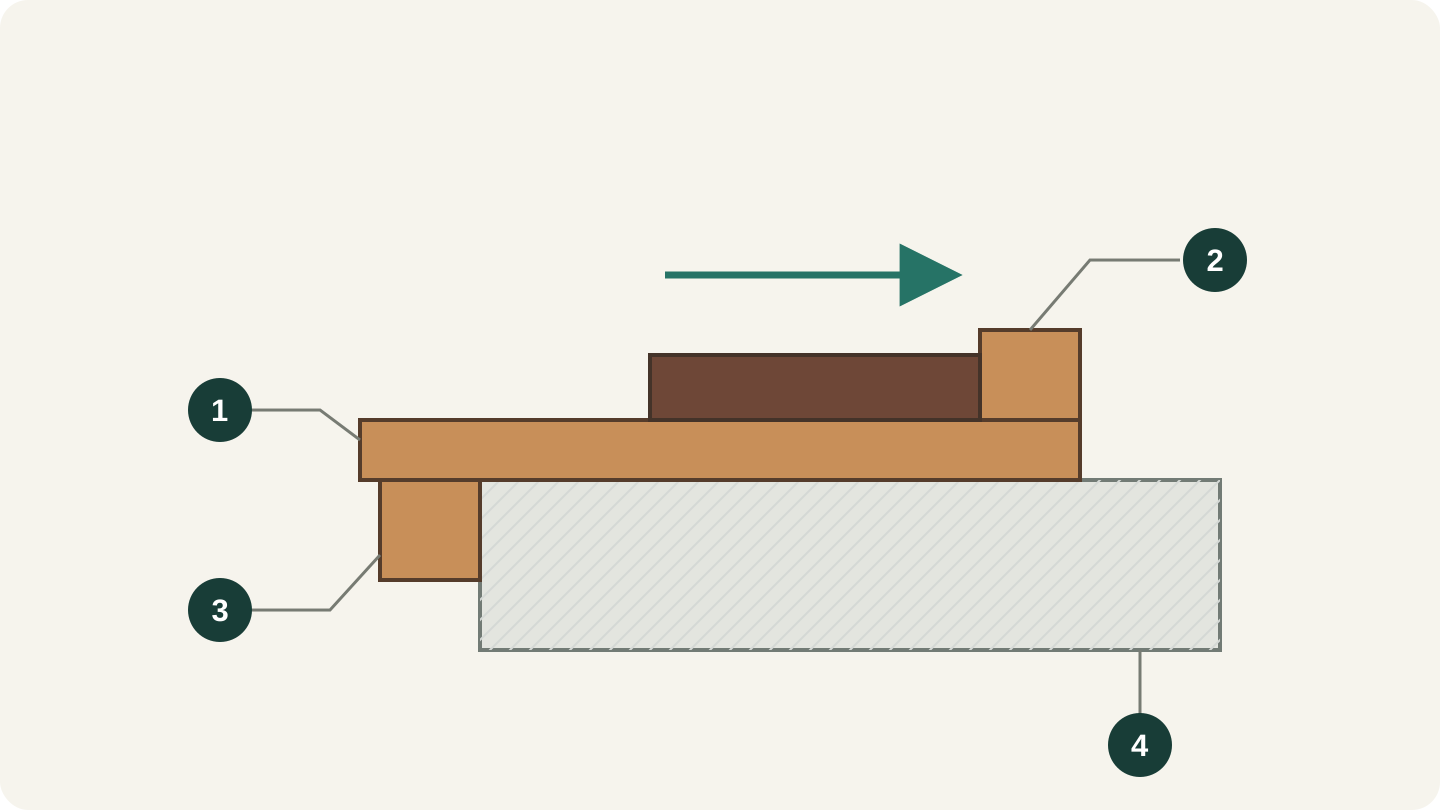
Side view: 1 is the base, 2 the upper stop, 3 the lower hook and 4 the workbench. Pressure toward the stop makes the lower hook catch the bench edge.
2. The Tool Tote
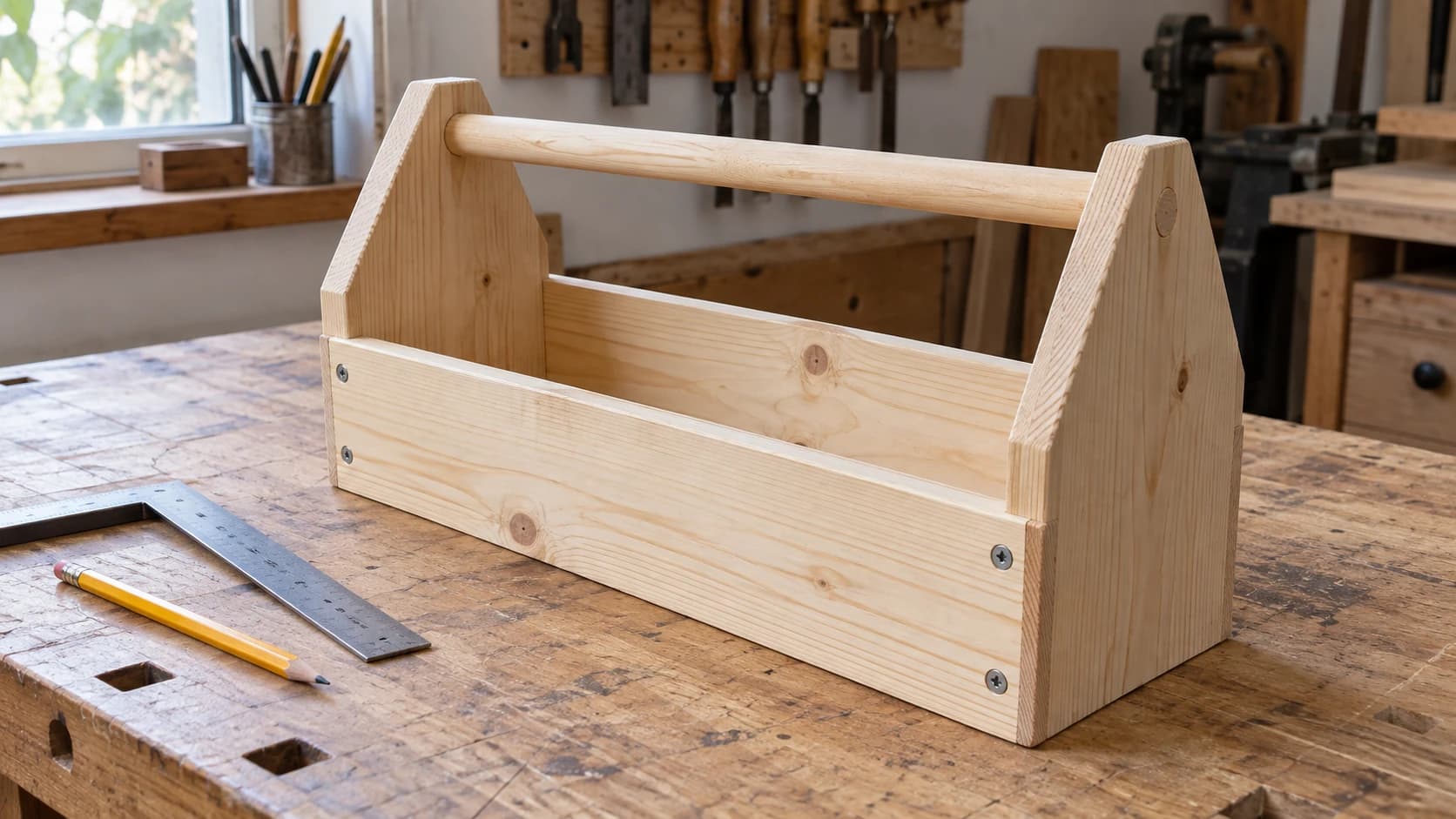
An open-top carrier with two angled ends, a bottom, two long sides, and a dowel handle. It looks like something from an old hardware catalog and it takes an afternoon.
The angled ends are the whole lesson. You'll cut your first non-90-degree angle, realize both ends have to match, and learn to cut them together as a pair so any error is identical on both sides. That trick, cutting matched parts together instead of measuring each one, is one of the highest-value habits in woodworking.
Use 1/2" or 3/4" pine. Screws are fine. Nobody has ever looked at a tool tote and asked about the joinery.
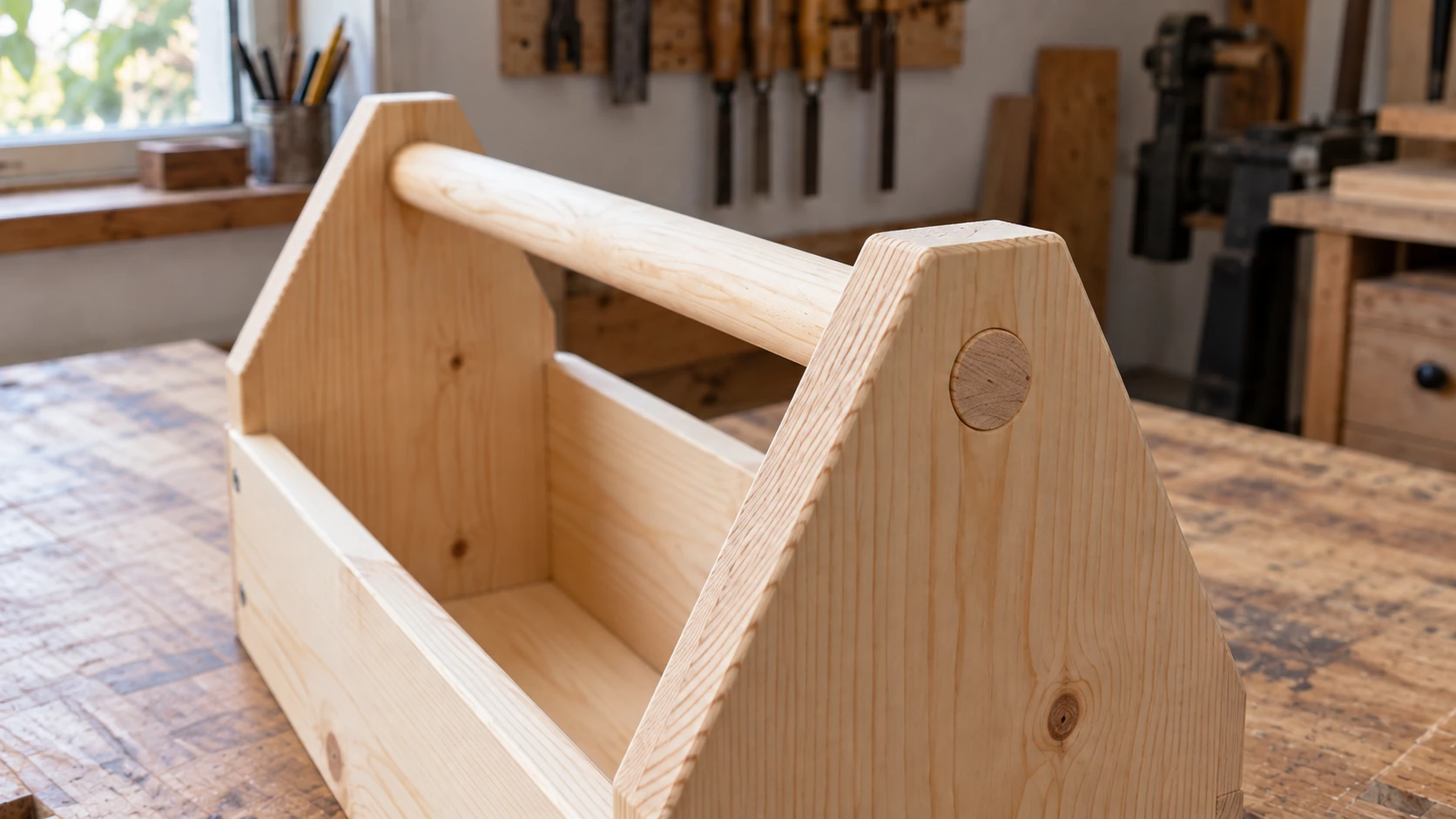
The handle fits into the end boards, with real wood surrounding the hole. A close view makes the joint and eased edges easier to understand.
3. The Cutting Board
The classic gift project, and the one everyone underestimates. Glue several strips of hardwood edge to edge, clamp, wait, flatten, sand, oil.
The waiting is real. Glue needs clamp time, so plan the glue-up for Saturday morning and everything else for Sunday. Check the bottle for the actual clamp and cure times, since they vary by glue and by how cold your shop is.
Warning
Cutting boards touch food. Use a glue rated as food-safe once cured, and finish with food-grade mineral oil or a mineral oil and beeswax blend. Skip stains and standard polyurethane on any surface a knife will touch.
What it teaches: flat, square glue-ups and the patience to sand properly. Most beginners stop sanding two grits too early. A cutting board punishes that immediately, because your hands can feel what your eyes miss.
4. The Floating Shelf With a French Cleat
A shelf that appears to grow out of the wall. The secret is a cleat: a board ripped at 45 degrees, one half screwed into the wall studs, the other half attached to the back of the shelf. The two halves hook together and gravity does the rest.
Half a day, one board, and the payoff is enormous relative to the effort.
What it teaches: finding studs, working level, and understanding that the strength of a wall-hung piece lives entirely in the anchoring, not the shelf. Get the cleat into studs. Drywall anchors alone are how shelves end up on the floor with your books.
5. The Picture Frame
This is the one project on the list that isn't forgiving, and it's here for exactly that reason. Four miters, four corners, and every degree of error shows up multiplied by four in a visible gap.
Build one anyway. It is the fastest way to learn that "close enough" has limits, and that a cut sled or a good miter setup earns its keep. Cut a frame's worth of scrap first, dry fit it, and see where you're off before you cut the good stock.
Tip
If your miters open up on the outside corners, your angle is under 45. If they open on the inside, you're over. Adjust in tiny increments, smaller than you think, and test on scrap every time. Miters are a game of thousandths dressed up as a game of degrees.
6. The Step Stool
Two sides, a top, one or two stretchers, done. But this one holds a human being, so it introduces the idea that a project can have consequences.
Build it with real joinery if you can: dadoes, or at minimum glue plus screws into edge grain rather than end grain alone. Add a stretcher near the bottom to keep the legs from splaying. Then stand on it, bounce a little, and pay attention to whether anything creaks or racks. That feedback loop is the actual lesson.
What it teaches: structure. Which parts carry load, which parts resist racking, and why a diagonal or a wide glued panel makes a wobbly thing rigid.
7. The Slatted Crate
A rectangular box with gaps between the slats. It's the most repetitive project here and that's why it works: you cut twelve identical short pieces and eight identical long ones, and if your cuts drift, the crate tells on you.
Make a stop block. Clamp a scrap to your saw fence at the length you want, butt each piece against it, cut. Every piece comes out identical without measuring a single one after the first. This is the moment a lot of people stop hating repetitive cuts.
The Small Pile of Tools That Covers All Seven
You don't need a shop. You need the ability to make a straight cut, hold two pieces together, and smooth the result.
| Category | Minimum viable | Nice upgrade |
|---|---|---|
| Cutting | A handsaw and a miter box | Circular saw with a guide, or a miter saw |
| Measuring | Tape measure, combination square, pencil | A quality try square you trust absolutely |
| Holding | Four clamps | Eight clamps, because it's always four more |
| Fastening | Wood glue and a drill/driver | Pocket hole jig |
| Smoothing | Sanding block and 3 grits | Random orbital sander |
One honest note on the square: buy a good one, and check it against a known straight edge. A square that's out of square silently ruins every project you build with it, and beginners spend months blaming their technique.
If you're building out a space rather than working off the kitchen table, our workshop setup guide covers layout, dust, and what to buy in what order.
Where Weekend Projects Actually Go Wrong
Five failure modes account for most abandoned garage plywood.
Cumulative measuring error. You measure part one, cut it, measure part two from the first cut, and by part six you're a quarter inch off. Fix: measure everything from the same reference face, or use a stop block for identical parts.
Out-of-square assembly. You glue it up, it looks fine, it dries as a parallelogram. Fix: measure both diagonals before the glue sets. Equal diagonals means square. Nudge until they match.
Wood that moved. You bought a board that looked flat under the fluorescent lights at the store, brought it into a humid garage, and by Sunday it's cupped. Fix: buy the flattest boards you can find, sight down them in the aisle, and let stock sit in your shop for a few days when you can.
Glue starvation or glue flood. Too little and the joint fails. Too much and squeeze-out soaks into the grain and blocks stain, leaving pale blotches around every joint. Fix: thin, even, both faces, and wipe squeeze-out while it's still wet.
Rushing the finish. The finish is 20% of the time and 80% of what people see. Sand through the grits properly, remove the dust, and let each coat dry as long as the can says. Our finishing guide covers oils, wipe-on poly, and the difference between them.
Asking Questions Mid-Build
The frustrating part of learning woodworking alone is that questions show up at the worst time. It's 4pm Saturday, you're standing over a glue-up that isn't closing, and the answer is somewhere in a 22 minute video you don't have time to scrub through.
That's the gap Craft Chat fills. It's the AI assistant built into Craftgineer, and it's free, though it uses your monthly chatbot message allowance rather than credits. Free accounts get 10 messages a month, and the paid tiers get considerably more. You'll need to be signed in.
The trick is asking with specifics. "How do I fix a wobbly stool" gets you a general answer. "My pine step stool racks side to side when I stand on it, the legs are attached to the top with glue and screws, no stretchers yet, what should I add" gets you something you can go do in the next ten minutes.
It also reads photos, which matters more than it sounds like. Snap a picture of a gap you can't diagnose or a glue-up that dried strange, and describing it stops being your problem. We wrote more about getting useful answers out of it in using AI chat to learn maker skills.
Save your messages for the moments that are actually blocking you. Reading a guide costs nothing.
Frequently Asked Questions
What wood should a beginner buy?
Pine or poplar. Both are cheap, both cut easily with hand tools, and both are forgiving of mistakes. Poplar takes paint better and pine takes a rustic oil finish better. Save hardwoods for after you've stopped making beginner cuts on them.
Do I need a table saw?
No. Every project on this list can be built with a handsaw and a miter box, or with a circular saw and a straight-edge guide. A table saw makes repeated rip cuts faster, not possible.
How do I cut a straight line without fancy tools?
Clamp a straight board to your workpiece as a fence and run your saw against it. A clamped guide beats a steady hand every single time, and it costs nothing.
Screws or joinery for a first project?
Screws and glue. Joinery is a wonderful skill and a terrible place to start. Build five things that hold together, then learn to make them hold together beautifully.
How long does glue really need?
Check the bottle for the specific product, because clamp time and full cure time are different numbers and both vary with temperature and humidity. Plan your weekend around the longer one.
Pick One and Start
Not four. One.
If you own almost nothing, build the bench hook this afternoon. If you have a saw and want something to show for the weekend, build the tool tote. If someone has a birthday coming, build the cutting board on Saturday and finish it Sunday.
The pile of plywood in your garage isn't a failure. It's just a project that was two skills too big. Build something smaller, finish it, and use it. That's the whole trick.
And when you hit the inevitable 4pm question with glue drying on your hands, Craft Chat is right there.
Ready to try these tools?
Sign up free, no credit card required. Free tools available immediately.
Start Free